
Introduction and Early Growth
boAt was founded as “Imagine Marketing” in 2013 by Aman Gupta and Sameer Mehta with an initial capital of just ₹30 lakh. Interestingly, before boAt’s success, Aman Gupta had previously worked for JBL, a brand boAt would later directly compete against.
The company did not start by selling audio equipment; its first products were actually iPhone charging cables. Their major market entry occurred in 2016 when established players like Sony and JBL were selling products for ₹3,000 to ₹5,000. boat disrupted the industry by offering products in the same category for just ₹999, effectively cutting the market price in half.
By FY 2023, boAt had become the world’s second-largest wearable brand, commanding a 26% market share and reaching a revenue of more than₹3,000 crore.
2. The Marketing Strategy: Selling an Identity boAt’s early success wasn’t solely based on pricing; it was a masterclass in positioning. The founders didn’t just sell earphones; they sold an identity. They created the term “boAtheads,” inculcating a strong sense of community and belonging among their users.
3. Core Vulnerabilities and Strategic Failures Despite its massive early success, boAt’s foundation suffered from several fatal flaws that eventually led to a sharp decline:
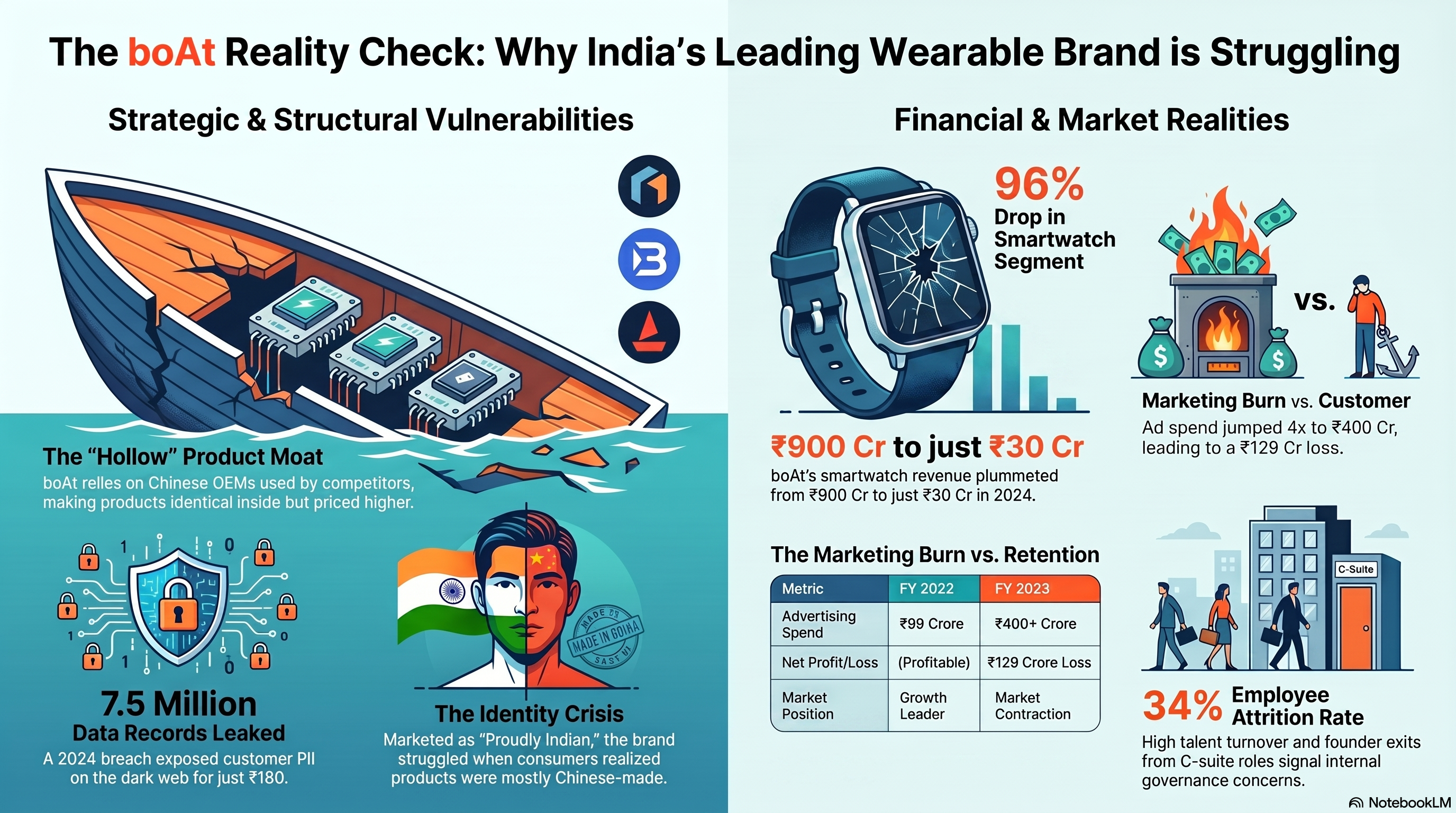
• OEM Dependency and Commoditization: boAt did not manufacture its own products; it relied entirely on Chinese Original Equipment Manufacturers (OEMs). The major issue was that these same OEMs were supplying identical hardware to competitors like Noise, Zebronics, and others . Consumers soon realized they were paying a ₹1,299 premium for a boAt product that was internally identical to a ₹799 Noise product. The consumer would not pay higher for a product which is not technologically superior.
• The “Made in India” Illusion: boAt heavily marketed itself as a “Proudly Indian” brand and a poster boy for “Aatmanirbhar Bharat”. However, a large portion of their products was manufactured in China, with only minor assembly happening in India. To control the damage when consumers caught on, the company had to launch a “Rock in India” campaign featuring comedian Ravi Gupta just to “prove” they had a factory in India—a significant indicator of shaky brand trust.
• Massive Data and Trust Breach: In April 2024, a the personal data (names, phone numbers, emails, addresses, and order details) of 75 lakh boAt customers on the dark web. This incident was a massive trust breach that shattered the blind faith consumers had placed in the brand.
• The Smartwatch Bubble Burst: In 2023, affordable smartwatches seemed like a daily necessity, but by 2024, the Indian smartwatch market collapsed by 34%. Consumers realized cheap smartwatches were a “try once” category, leading to zero upgrade cycles because the features didn’t become a permanent part of their daily lives. boAt’s revenue in this specific segment plummeted drastically from ₹900 crore to just ₹30 crore.
• The “Mid-Zone” Trap and Lack of Ecosystem: Users who actually wanted to upgrade their wearables migrated to Apple or Samsung for superior accuracy, trust, and ecosystem integration. boAt found itself stuck in a “mid-zone trap”: it couldn’t compete with the ultra-aggressive pricing of lower-end brands like Fire-Boltt, nor could it compete with the mature, premium ecosystems of Apple and Samsung. boAt lacks a dedicated operating system, exclusive apps, or hardware lock-ins that force customer loyalty, meaning customers can switch brands without a second thought.
• Unsustainable Marketing Burn: To maintain its hyper-growth, boAt’s advertising expenses skyrocketed from ₹99 crore in FY 2022 to over ₹400 crore in FY 2023—a 4x jump in just one year. Because the underlying products lacked real differentiation, customer retention was incredibly low. This dynamic resulted in a staggering ₹129 crore loss in FY 2023, despite generating over ₹3,000 crore in revenue.
4. Leadership Exodus and Internal Turmoil The internal stability of the company also began to fracture. After multiple delays to a ₹2,000 crore IPO due to losses and governance concerns, the company planned to file a revised ₹1,500 crore IPO. However, just 29 days before this filing, co-founders Aman Gupta and Sameer Mehta suddenly stepped down from their respective CMO and CEO positions. While the company framed this as “professionalization,” the market viewed it as a massive red flag.
Furthermore, employee attrition skyrocketed. The turnover rate went from 27% in FY 2023 to 34% by FY 2025. One out of every three employees was leaving the company every year, which analysts labelled a “mass exodus,” indicating deep-rooted internal issues despite the existence of a large Employee Stock Ownership Plan (ESOP).
“.
KEY INSIGHT
boAt successfully built a brilliant brand and marketing engine but failed to stay. To survive long-term, the company must evolve by building an integrated tech ecosystem, investing heavily in genuine product innovation, and seriously entering the premium segment to create real differentiation. Otherwise, it risks becoming just another easily replaceable commodity brand.
Discussion Questions for Students
1. Brand Positioning vs. Product Differentiation: How did boAt successfully use pricing and community-building (e.g., “boAtheads”) to disrupt the market in 2016? Why did this marketing-first strategy eventually fail to retain customers?
2. Supply Chain Risks: Discuss the long-term dangers of boAt’s heavy reliance on Chinese Original Equipment Manufacturers (OEMs). How does selling identical hardware to your competitors affect a brand’s pricing power and market position?
3. Consumer Trust and Ethics: Analyze the fallout from the “Made in India” discrepancy and the April 2024 dark web data breach. How do incidents like these impact a brand’s perceived value, and what steps should a company take to rebuild consumer trust?
4. Market Trends and Product Life Cycles: Explain the “Smartwatch Bubble Burst” of 2024. Why did consumers treat affordable smartwatches as a “try once” category, and what does this indicate about building products based on hype versus daily utility?
5. The Importance of an Ecosystem: What is the “Mid-Zone Trap,” and how did boAt fall into it? Compare boAt’s standalone product strategy with the ecosystem models used by Apple and Samsung. Why is an ecosystem critical for customer retention?

The moment when people got to know that BoAt is just adding its label on Chinese Products. The downfall went further.
Customers need durable and reliable products (even in case of economical pricing).
Even I have used the product personally in 2021. I found it worthless.
The case study is a prime example of how innovative start ups , despite their good products, can fail to see the full life cycle growth due their excessive cash burn , high Custer acquisition cost and poor governance .
A good reading
Great content
So interesting
Wowww
Amazing article
Great example of how branding drives growth but innovation sustains it.
Good case study on how not to do marketing.boAt’s strategy exposed weaknesses, including heavy reliance on branding, misleading “Made in India” claims, loss of trust after the data breach, and weak customer loyalty.
It’s an interesting read on how the 5Ps are so critical to any brand’s success and when these 5 do not exist in cohesion, the brand is bound to fail.
Excellent case study. boAt’s journey proves that strong marketing can help a brand win customers, but long-term success depends on product innovation, consumer trust, and a sustainable ecosystem. The discussion around OEM dependency, the smartwatch market collapse, and the lack of differentiation offers valuable lessons for every startup. Growth is impressive, but staying relevant is the real challenge.
A powerful reminder that branding can attract customers, but innovation and trust keep them. boAt built a remarkable brand, yet the lack of product differentiation and ecosystem strength exposed its vulnerabilities. A valuable lesson for startups chasing growth without building a lasting competitive advantage.
Got to know great things really knowledgeable content