
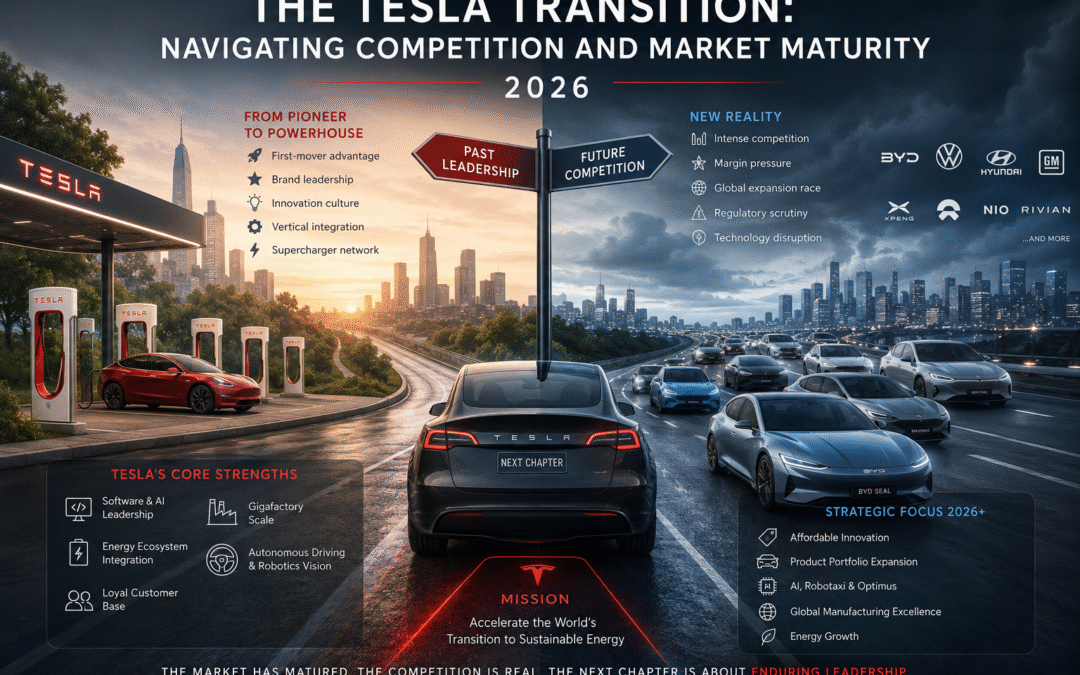
The case highlights the market challenges and public scrutiny facing Tesla as it navigates a transition from a high-growth startup to a mature automaker by 2026. It highlights how increased global competition, particularly from Chinese manufacturers and established European brands, has ended Tesla’s era of uncontested dominance. The narrative explores how aggressive price cuts initially intended to drive demand eventually pressured profit margins and altered consumer psychology regarding vehicle value. Furthermore, it examines the polarizing influence of Elon Musk’s public persona and the impact of aging product designs on brand loyalty. Economic factors like high interest rates and shifting buyer demographics are also identified as key drivers of the company’s recent sales slowdown. Ultimately, Tesla is experiencing natural growing pains as it attempts to balance its identity as a revolutionary tech firm with the operational realities of the modern automotive industry.
In early 2026, Tesla is undergoing a significant transition from a period of explosive, unrivaled growth to a phase of market maturity and intense competition. While the company dominated the electric vehicle (EV) conversation just a few years prior, the narrative has shifted as quarterly delivery reports show a noticeable slowdown in key markets.
The current “backlash” facing the company is driven by several critical factors:
- Increased Global Competition: By 2026, the competitive landscape has changed entirely. Legacy automakers have fully transitioned to electric lineups, and companies like BYD have expanded aggressively in Asia and Europe. Tesla no longer operates on an empty playing field, especially as domestic incentives in the U.S. now favor a wider range of manufacturers.
- Pricing Strategy and Margin Pressure: Tesla’s decision to slash prices in 2023 and 2024 to maintain volume has squeezed profit margins. This strategy also created a “psychological problem” where potential buyers delay purchases, expecting even deeper price cuts in the future.
- Brand and Leadership Controversy: Public perception of the Tesla brand has become increasingly polarized, partly due to Elon Musk’s outspoken presence on social media. Critics argue his external ventures—ranging from AI to social media—dilute his focus on Tesla’s core business.
- Product Stagnation: While the Model 3 and Model Y remain top sellers, by 2026, consumers are demanding more frequent design upgrades and interior innovations that competitors are delivering more rapidly.
- Autonomous Driving Hurdles: Despite improvements in Full Self-Driving (FSD) beta versions, regulatory approval remains complex, and progress has been slower than many early adopters initially expected.
Beyond these internal pressures, Tesla is navigating a difficult macroeconomic backdrop. High interest rates have increased financing costs for car buyers, and cooling economic growth in China has dampened consumer confidence. This shift is particularly impactful because the EV market has moved beyond early adopters to mainstream buyers who are more price-sensitive and cautious.
Despite these challenges, the sources emphasize that Tesla is transitioning rather than collapsing. The company still generates tens of billions in annual revenue, operates massive gigafactories on three continents, and maintains one of the world’s most reliable Supercharger networks. Analysts are now looking toward upcoming catalysts, such as a next-generation vehicle platform designed to lower production costs and further advancements in energy storage and battery technology. Ultimately, Tesla’s future depends on its ability to stabilize margins and maintain innovation speed in a market that no longer offers “automatic applause”.
Q1.How is Tesla’s energy storage division performing in 2026?
Q2.What specific challenges is Tesla facing in the Chinese market?
Q3.How does the shift from “early adopters” to “mainstream buyers” change what customers prioritize when choosing a vehicle?
Q4.What are the upcoming catalysts that analysts believe could help Tesla regain its momentum?
Q5.Despite the backlash, what structural advantages does Tesla still maintain over other automakers?
